Cornwall’s biggest eclipse since 1999 arrives this evening
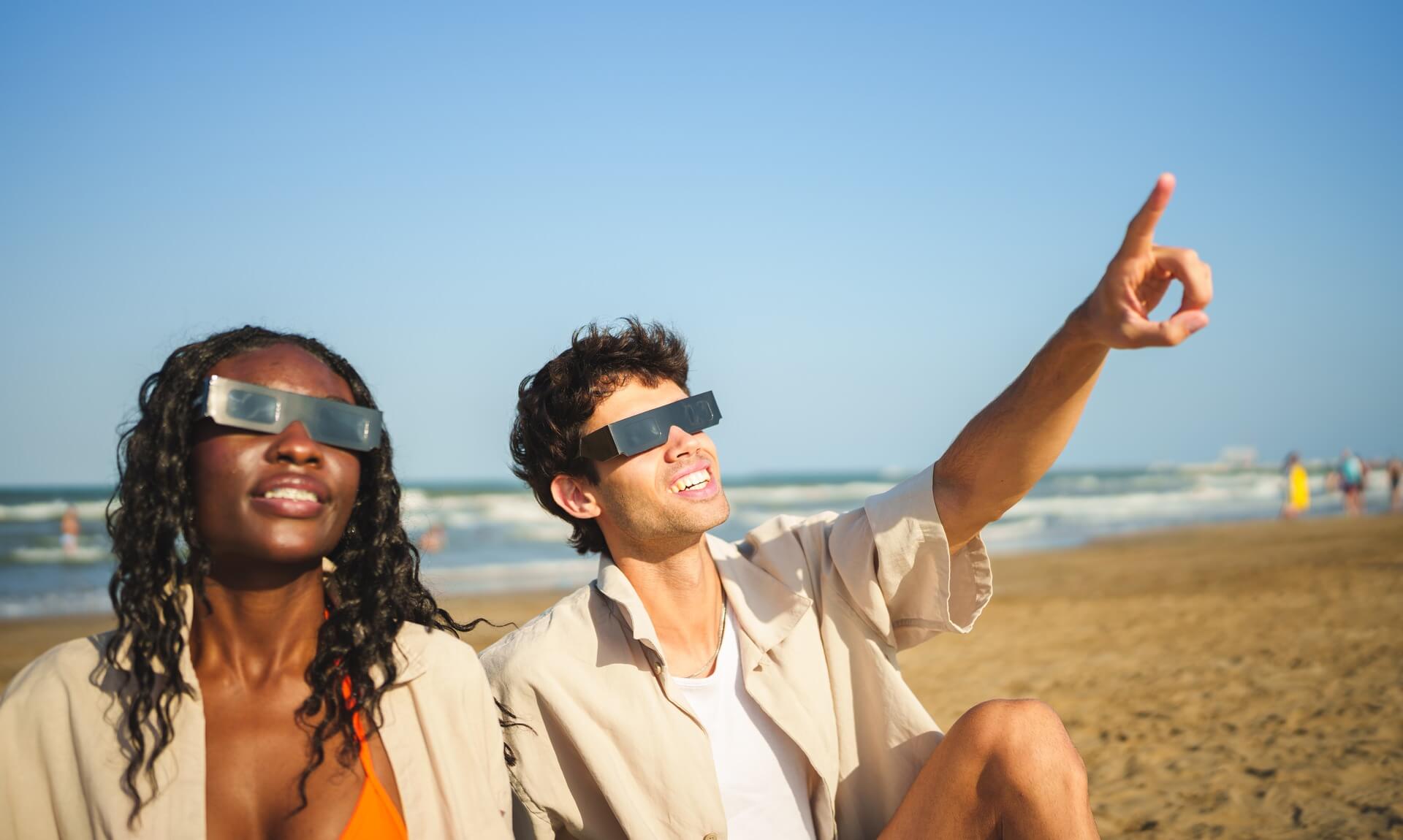
Look to the west this evening and, cloud permitting, you can watch the sun shrink to a thin curve of light as the moon slides across it. Most of Cornwall will see around 95 per cent of the sun blotted out. The county has not had a sky show on this scale since the summer of 1999.
Your daily dose of Cornwall
News, events and goings on across the Duchy
What happens tonight, and when
Wednesday 12 August brings a deep partial solar eclipse to the whole of the UK, and the far south-west gets the best of it. The closer you stand to the eclipse track, the more of the sun disappears, and Cornwall and the Isles of Scilly are the nearest scrap of Britain to it.
At the tip of the Isles of Scilly, Bishop Rock lighthouse reaches about 96.5 per cent coverage. Land’s End sees roughly 95.8 per cent, and Lizard Point, the most southerly place on the mainland, about 95.6 per cent. Across the rest of Cornwall it sits at around 95 per cent.
The timing suits an after-work look. The partial phase begins at roughly 6.15pm, reaches its maximum at about 7.15pm, and finishes just after 8pm. The catch is height. The sun will be low in the west-north-west, only a little way above the horizon, so you need a clear, open view in that direction. A west-facing beach, a clifftop or high ground looking out to sea is close to ideal, which is one thing Cornwall has no shortage of. The Royal Observatory Greenwich is also running a free live stream for anyone clouded out.
Why Cornwall gets the best seat in Britain
This is a total eclipse, but not here. The path of totality, the narrow strip where the moon blocks the sun completely, runs out across the Atlantic to the south-west of Britain, then on over the western tip of Iceland, a corner of Greenland and down into northern Spain, taking in A Coruña, Bilbao, Zaragoza and Valencia. Along that line the sky goes fully dark for up to two minutes and 18 seconds.
Cornwall sits just outside it. That is why the county lands a very deep partial rather than the real thing, and why coverage climbs the further south and west you go. Penzance, the Lizard, Land’s End and Scilly are the front row.
The last time the sky went dark
Anyone in Cornwall on 11 August 1999 will remember it. At 11.12 in the morning the moon covered the sun completely, and for about two minutes the middle of the day turned to a strange silvery dusk. It was the first total eclipse visible from mainland Britain since 1927.
Around a million people came to Cornwall to see it, close to doubling the county’s population overnight. The A30 ground to a halt, accommodation had been booked for months, and plenty of visitors ended up sleeping in cars, fields and on beaches. As totality arrived the temperature dropped, birds fell quiet, the horizon glowed like a sunset in every direction, and strangers hugged on hilltops.
The one thing Cornwall could not order was the weather. Cloud rolled in across much of the county through the morning, and many people lived the eerie darkness without ever seeing the sun itself. Devon and the Isles of Scilly fared a little better. Whether Cornwall’s skies stay clear enough this evening is again the question that decides everything.
Your daily dose of Cornwall
News, events and goings on across the Duchy
How to watch it without hurting your eyes
Here is the part that matters most. Because Cornwall only reaches about 95 per cent and never full totality, there is no safe moment to look at the sun with bare eyes at any point this evening. Even a sliver of direct sun can burn the back of the eye without you feeling it happen.
The safe ways to watch:
- Use proper eclipse glasses marked ISO 12312-2. Check them first for scratches, holes or creases, and bin any that are damaged.
- Try pinhole projection. Punch a small hole in a piece of card, hold it up to the sun and let the light fall onto a second sheet behind it. A kitchen colander does the same job and casts dozens of tiny crescents. It is the easiest and safest option with children.
- Do not use ordinary sunglasses, even several pairs stacked together. They are nowhere near dark enough.
- Never look at the sun through a phone camera, binoculars or a telescope unless a proper solar filter is fitted over the front. The concentrated light can blind you in an instant and wreck the device.
Keep a close eye on younger children throughout, and if in any doubt at all, projection is the method that cannot go wrong.
Where will you be watching?
Cornwall is about as well placed as anywhere in the country for this one, and the best spots are the ones with a clean horizon out to the west. Land’s End, the Lizard, Sennen, Pendeen and the west-facing beaches around Mount’s Bay and the north coast all give you the open sky the low sun needs. Higher ground with nothing blocking the view works just as well.
So where are you heading to catch it? Tell us in the comments where you will be watching from, and send in your photos afterwards. We would love to see the crescent sun from every corner of the county.
One number puts the evening in perspective. The next total solar eclipse over mainland Britain will not arrive until 23 September 2090. For most of us a 95 per cent Cornish sunset is as close as we are going to get, so it is worth stepping outside for. Cloud permitting.
Read Next
Share This Story, Choose Your Platform!
To keep up with the latest cornish news follow us below
Follow CornishStuff on Facebook - Like our Facebook page to get the latest news in your feed and join in the discussions in the comments. Click here to give us a like!
Follow us on Twitter - For the latest breaking news in Cornwall and the latest stories, click here to follow CornishStuff on X.
Follow us on Instagram - We also put the latest news in our Instagram Stories. Click here to follow CornishStuff on Instagram.
- 1
- 2
- 3
- 4
- 5
- 6