Oxbridge-bound Launceston College leavers write to the Trust
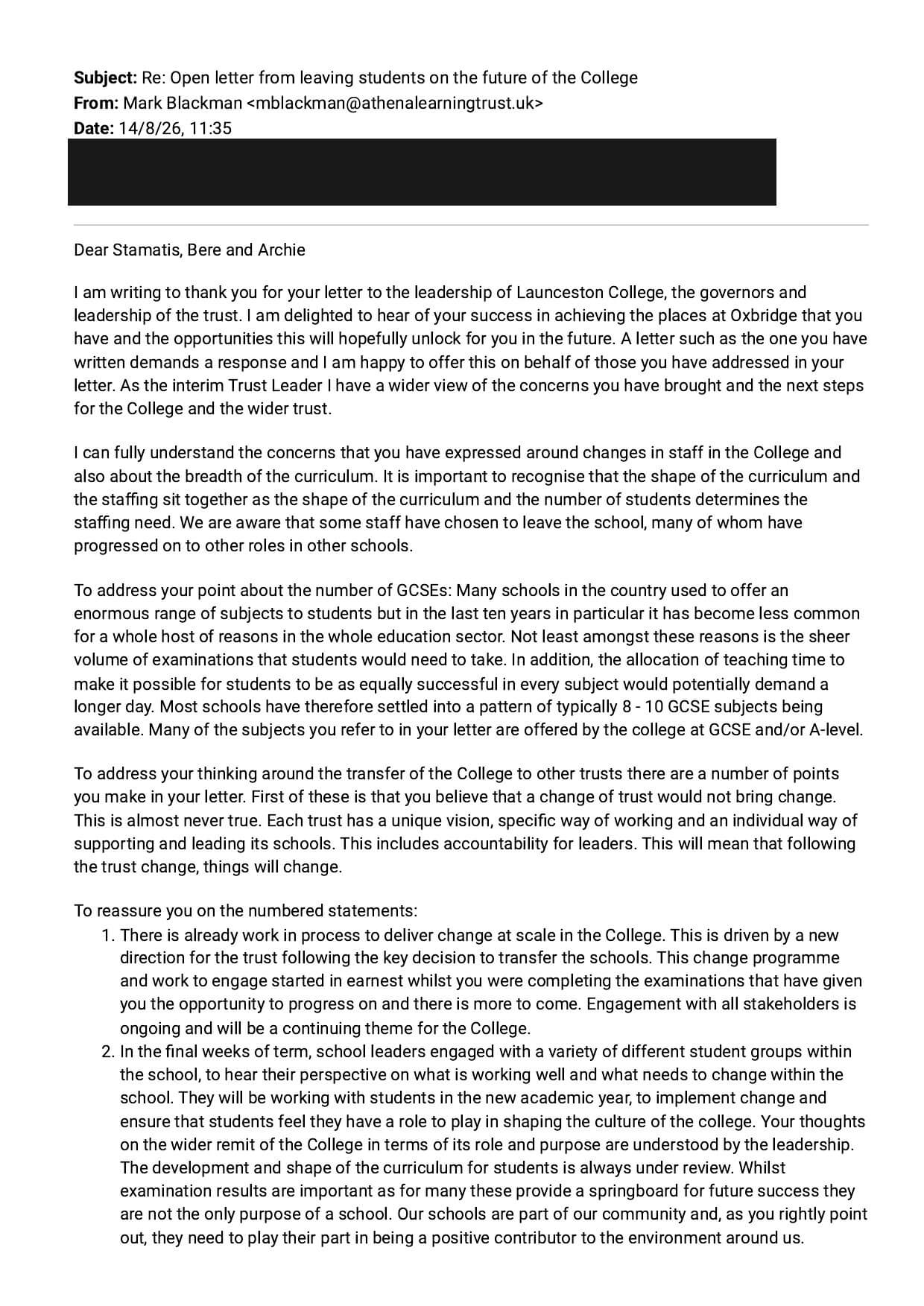
Results day usually ends with a photograph on the school field and a phone call home. For three Launceston College leavers it ended with a letter. All three had just had places at Oxford or Cambridge confirmed. Their argument, sent to the people who run their old school on the same afternoon, was that the school which got them there is no longer the school they arrived at.
Your daily dose of Cornwall
News, events and goings on across the Duchy
Three leavers, one letter
Stamatis Mavroudi-Tayler, Bere Wendriner and Archie Gough collected their A-level results on Thursday 13 August.
Stamatis has a confirmed place to read Mathematics and Computer Science at Oxford, after A* grades in Maths, Further Maths and Physics. Bere, a former Head Student, is going to Oxford to read Music, with A* grades in History, French and English Literature and a distinction in Grade 7 Music Theory. Archie, also a former Head Student, has a place to read History at Cambridge, with an A* in French at A-level and in an Extended Project Qualification.
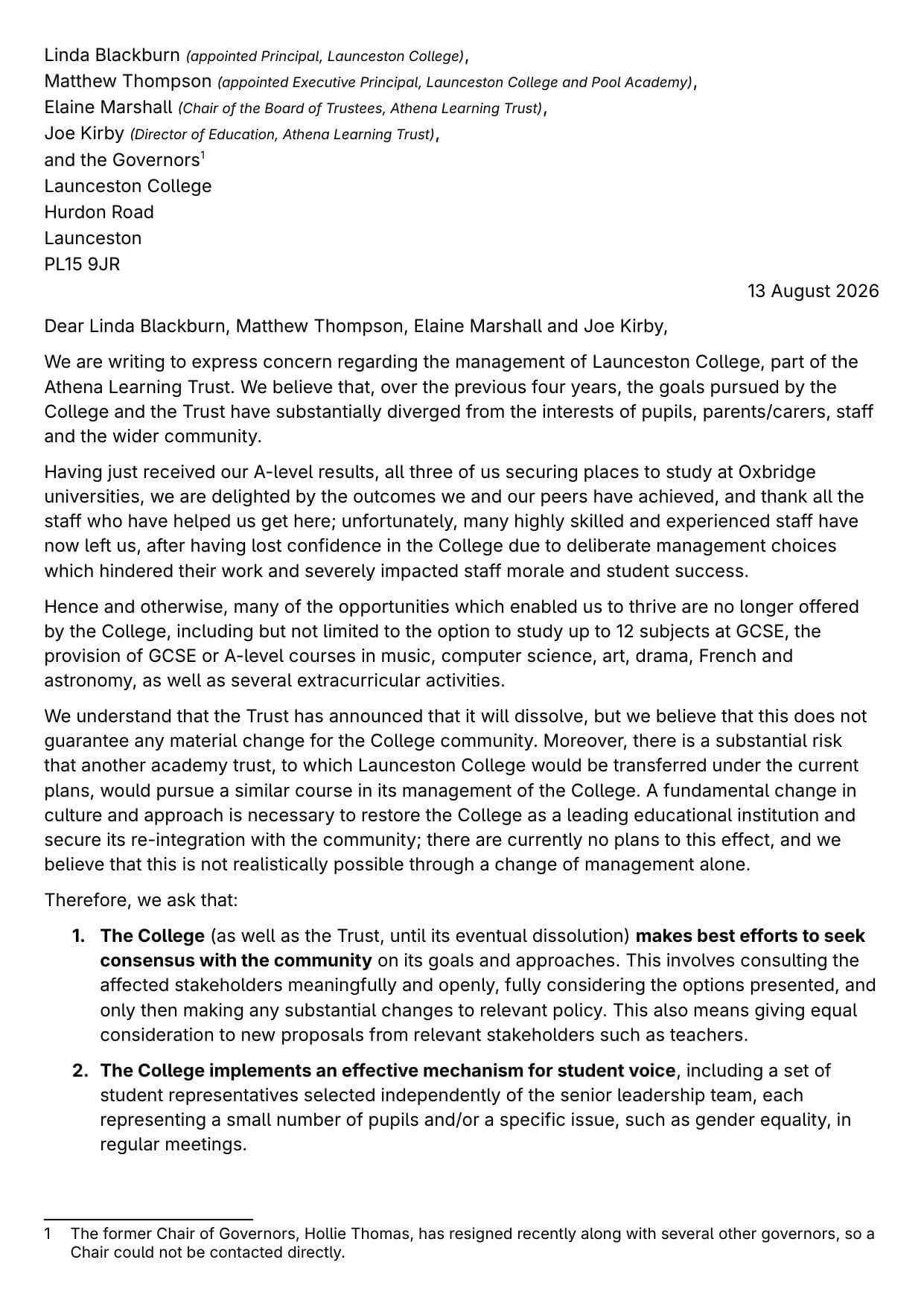
By late afternoon the same day, the three had emailed a joint letter to Linda Blackburn, the appointed Principal at the college, and Matthew Thompson, appointed Executive Principal of Launceston College and Pool Academy. It also went to Elaine Marshall, Chair of the Board of Trustees at Athena Learning Trust, and Joe Kirby, the trust’s Director of Education. They told the recipients they intended to publish the letter, and might publish any replies.
The letter opens by expressing concern about the management of the college. Over the previous four years, the three write, the goals pursued by the college and the trust have substantially diverged from the interests of pupils, parents and carers, staff and the wider community.
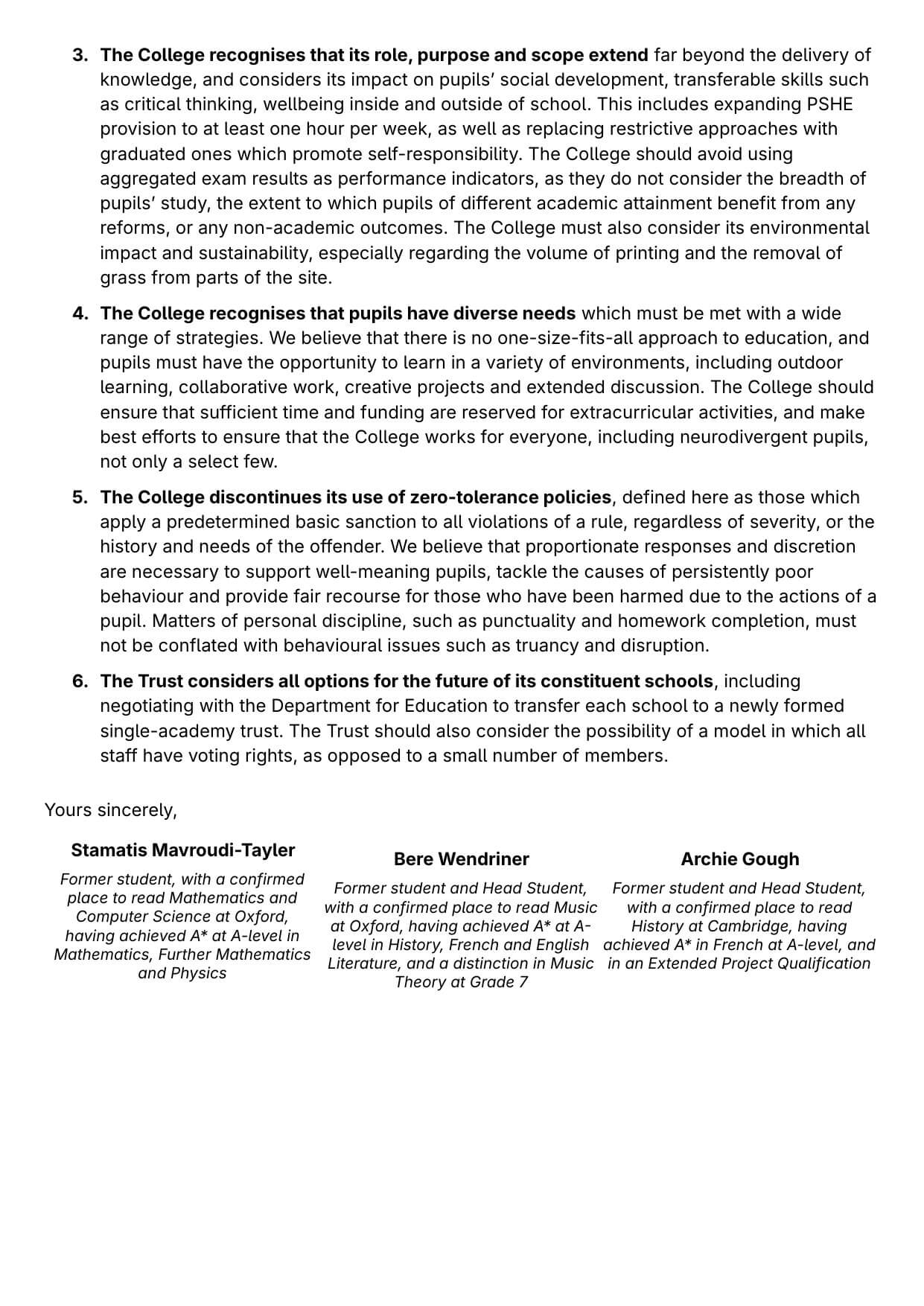
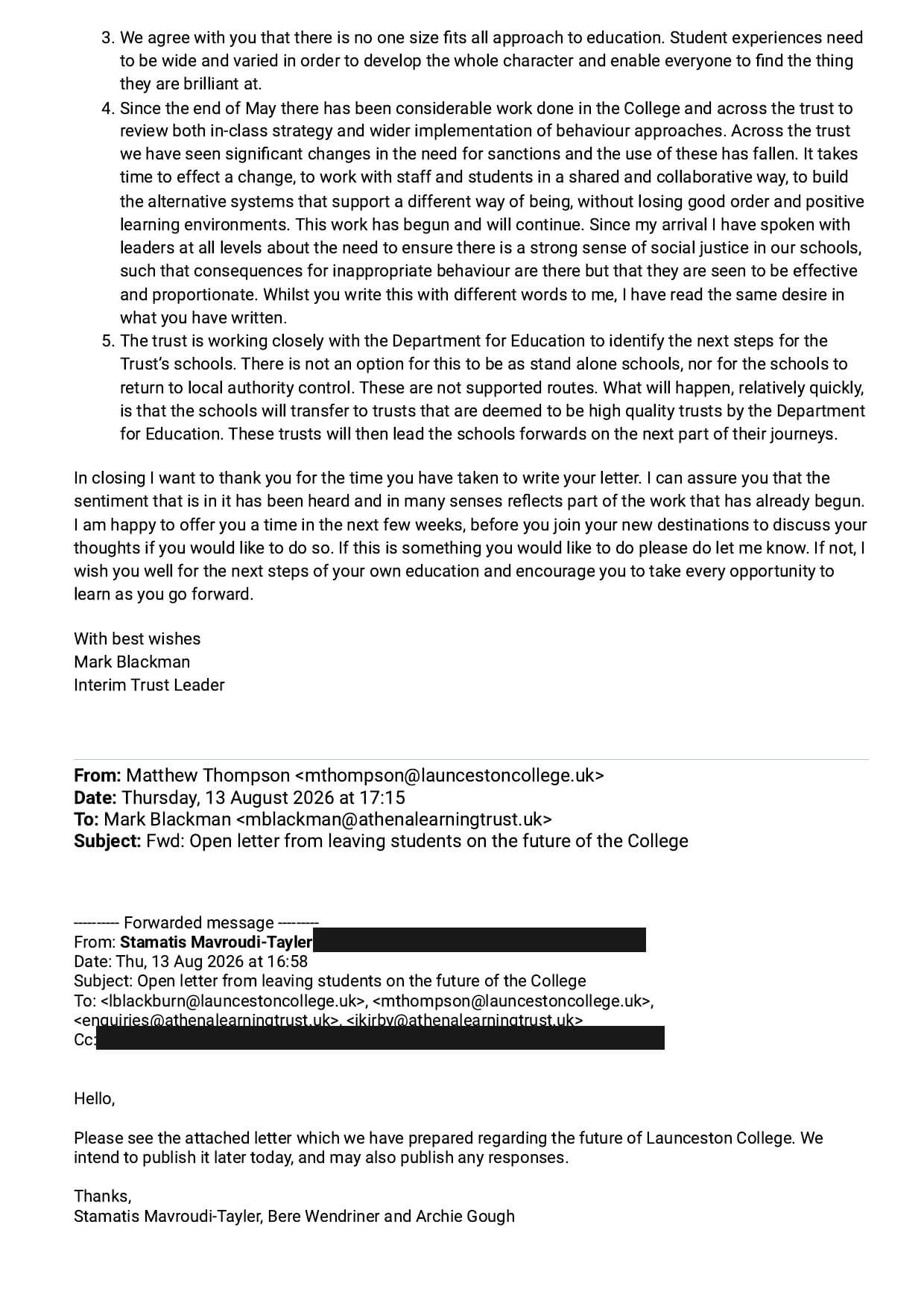
Both the letter and the reply are reproduced in full through this article.
What the letter says has been lost
The three thank the staff who helped them get their grades, then say many highly skilled and experienced staff have since left, having lost confidence in the college. They put that down to management choices which they say hindered staff work and hit both morale and student success.
They then set out what they say is no longer on offer: the option to study up to 12 subjects at GCSE, GCSE or A-level courses in music, computer science, art, drama, French and astronomy, and several extracurricular activities.
The letter does not say when each of those changes took effect. Both Archie and Bere took French at A-level themselves.
The six things they asked for
The bulk of the letter is a numbered list of requests. In summary, the three ask that:
- The college and the trust seek consensus with the community on their goals, consulting people meaningfully and openly before making substantial changes to policy, and giving equal weight to proposals from staff.
- The college sets up a working student voice mechanism, with representatives chosen independently of the senior leadership team, each covering a small group of pupils or a specific issue, meeting regularly.
- The college treats its role as wider than the delivery of knowledge, expands PSHE to at least an hour a week, drops aggregated exam results as a performance measure, and looks at its environmental impact, including the volume of printing and the removal of grass from parts of the site.
- The college recognises that pupils have different needs, with time and funding reserved for extracurricular activities and for varied ways of learning including outdoor work, collaborative projects and extended discussion, so that the school works for neurodivergent pupils and not only a select few.
- The college drops zero-tolerance policies, which the letter defines as those applying a set basic sanction to every breach of a rule regardless of how serious it was or the history and needs of the pupil. The three also argue that punctuality and homework should not be treated the same way as truancy and disruption.
- The trust considers every option for its schools, including negotiating with the Department for Education to move each one into a newly formed single-academy trust, and looks at a model where all staff have voting rights rather than a small number of members.
On the trust’s dissolution, announced in July and reported by CornishStuff at the time, the three write that winding up the trust does not on its own guarantee any material change, and that there is a substantial risk a new trust would take a similar approach.
Your daily dose of Cornwall
News, events and goings on across the Duchy
The trust’s reply, the next morning
Mark Blackman, Interim Trust Leader at Athena Learning Trust, answered at 11.35 the following morning, writing on behalf of everyone the letter had been addressed to. He congratulated the three on their places and said a letter such as theirs demands a response.
On staffing, Mark wrote that the shape of the curriculum and the staffing sit together, because the curriculum and the number of students determine the staffing need. Some staff had chosen to leave, he said, many of them moving on to roles in other schools.
On the number of GCSEs, he wrote that many schools in the country used to offer an enormous range of subjects, and that this has become less common across the education sector over the past ten years for a whole host of reasons. Among them, he said, are the sheer volume of exams pupils would have to sit and the teaching time that equal success in every subject would demand, which could push towards a longer school day. Most schools, he wrote, have settled on around eight to ten GCSE subjects. He added that many of the subjects named in the letter are offered by the college at GCSE, A-level or both.
On the students’ view that a change of trust would not bring change, Mark was blunt. That is almost never true, he wrote. Each trust has a unique vision, a specific way of working and its own way of supporting and leading its schools, including how leaders are held to account.
He went on to say that a change programme is already under way at the college, driven by the decision to transfer the schools, and that it started while the three were sitting their exams. School leaders met a variety of student groups in the final weeks of term, he wrote, and will work with pupils in the new academic year on shaping the culture of the college. He agreed there is no one-size-fits-all approach to education.
On behaviour, Mark wrote that since the end of May there has been considerable work across the college and the trust reviewing in-class strategy and the wider use of behaviour approaches, and that the need for sanctions has fallen. He said he had spoken to leaders at all levels about the need for a strong sense of social justice in the schools, with consequences that are seen to be effective and proportionate. Although the three had used different words to his own, he wrote, he read the same desire in what they had written.
What happens to the college now
The reply also contains the clearest statement yet on where Launceston College is heading, and it closes off one of the letter’s six requests.
The trust is working closely with the Department for Education on next steps, Mark wrote, and there is not an option for the schools to stand alone, nor for them to return to local authority control. Those are not supported routes. What will happen, relatively quickly, is that the schools will transfer to trusts the Department for Education considers to be high quality, and those trusts will lead them on from there.
That rules out the single-academy trust route the three had asked the trust to explore. No receiving trusts have been named, and families across Cornwall are still waiting to hear which organisations will take the schools on.
Mark ended by offering the three a meeting in the next few weeks, before they leave for university, if they would like to discuss their thoughts.
The students are not satisfied
Writing to CornishStuff, Stamatis said he welcomed the fact that the trust took the time to acknowledge their points. But he said the reply fails to address their concerns specifically, and does not indicate any form of commitment to, or even consideration of, any part of their suggestions.
The three have asked for their letter to be published as part of what they describe as an effort to put the college back on course as both a leading and community-driven institution. Whether the meeting happens before they leave for Oxford and Cambridge is now down to them.
Read Next
- BusinessA holiday in Cornwall priced to compete with a city break in Copenhagen.
Share This Story, Choose Your Platform!
To keep up with the latest cornish news follow us below
Follow CornishStuff on Facebook - Like our Facebook page to get the latest news in your feed and join in the discussions in the comments. Click here to give us a like!
Follow us on Twitter - For the latest breaking news in Cornwall and the latest stories, click here to follow CornishStuff on X.
Follow us on Instagram - We also put the latest news in our Instagram Stories. Click here to follow CornishStuff on Instagram.
- 1
- 2
- 3
- 4
- 5
- 6